Tuesday, December 21, 2010
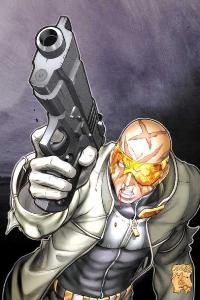
Agent X

green arrow
 Green Arrow is an archerwho invents trick arrows with various special functions, such as glue arrows, net arrows, explosive arrows, time bomb arrows, grappling arrows, fire extinguishing arrows, flash arrows, tear gas arrows, cryonic arrows, boxing-glove arrows, and even a kryptonite arrow. Originally developed as an archery-themed analogue of the very popular Batman character, writers at DC have developed Green Arrow into a voice of left-wing and progressive politics very much distinct in character from Batman, with his own supporting cast.
speedy the archer

Roy Harper was raised by Brave Bow, a Navajo medicine chief after his father, a forest ranger, died in a forest fire.
Under Brave Bow's tutelage, Roy became a remarkable archer, and, after Brave Bow's death, Roy was adopted by Oliver Queen, the Green Arrow, and became the Green Arrow's sidekick, "Speedy."
static bizzzzzzzzzzzzzz!
 cDuffie has stated that the creation of Static was a group effort. Originally developed forMarvel Comics, Static would become a main staple of the Milestone Comics line. Much of the inspiration for Static's character came from Marvel's Spider-Man. When initially creating the first five characters for the Milestone Comic Book Line, it was decided that Static would be created as a teenage hero who was a contemporary version of Spider-Man.[1][2] AnAfrican American teen, Static was a key character of Milestone Comics, an independently-owned imprint of DC Comics specializing in minority heroes. Milestone ceased publishing comics in 1997 but Static was saved from obscurity by the WB animated series Static Shock, which aired for four seasons and led to the 2001 comic book miniseries Static Shock: Rebirth of the Cool. [3]
spidy
 character was created by writer-editor Stan Lee and writer-artist Steve Ditko. He first appeared in Amazing Fantasy #15 (Aug. 1962). Lee and Ditko conceived of the character as an orphan being raised by his Aunt May and Uncle Ben, and as a teenager, having to deal with the normal struggles of adolescence in addition to those of a costumed crime fighter. Spider-Man's creators gave him super strength and agility, the ability to cling to most surfaces, shoot spider-webs using devices of his own invention which he called "web-shooters", and react to danger quickly with his "spider-sense", enabling him to combat his foes.
When Spider-Man first appeared in the early 1960s, teenagers in superhero comic books were usually relegated to the role of sidekick to the protagonist. The Spider-Man series broke ground by featuring Peter Parker, a teenage high school student to whose "self-obsessions with rejection, inadequacy, and loneliness" young readers could relate.[1] Unlike previous teen heroes such as James Buchanan "Bucky" Barnes and Robin, Spider-Man did not benefit from being the protégé of any adult mentors like Captain America and Batman, and thus had to learn for himself that "with great power there must also come great responsibility" — a line included in a text box in the final panel of the first Spider-Man story, but later retroactively attributed to his guardian, the late Uncle Ben.
moon knight!

e character debuted in the title Werewolf by Night #32 (August 1975), written by Doug Moench with art by Don Perlin, as an enemy of the title character in a two part story continuing in issue #33. The character proved popular with readers, and was granted a solo spot in Marvel Spotlight #28-29 (1976), written by Doug Moench with art by Don Perlin.
He then had appearances in Spectacular Spider-Man issues #22 and #23, both written byBill Mantlo with art by Mike Zeck on #22 and Jim Mooney on #23; Marvel Two-In-One #52, written by Steven Grant with art by Jim Craig; and Defenders #47-50. Moon Knight then gained a backup strip in the Hulk! Magazine in issues #11-15, #17-18, and #20, as well as Marvel Preview #21 (on which he was the cover feature), all written by Doug Moench. Art was done by Gene Colan in #11, Keith Pollard in #12, and Bill Sienkiewicz on the rest. These were reprinted in Moon Knight Special Edition #1-3.
A new ongoing series was then launched, titled Moon Knight, which also had writing by Doug Moench and art by Bill Sienkiewicz
cyclops

a superhero who is the field leader of theX-Men in the Marvel Comics Universe. A mutant, Cyclops produces a powerful beam with great destructive power from his eyes referred to as an "optic blast". In uniform, he wears a unique ruby quartz battle visor with a lens which runs from eye-to-eye giving him a one-eyed appearance, hence the codename "Cyclops."
Created by writer Stan Lee and artist/co-writer Jack Kirby, he first appeared in The X-Men #1September 1963. Originally dubbed Slim Summers, by X-Men #3 his name was changed to Scott and Slim was referred as a nickname. Scott is the first X-Man recruited by Charles Xavier and as one of the original five X-Men, Cyclops has had a large presence in X-Men-related comics since their inception.
Cyclops is typical of the archetypal hero in American popular culture as opposed to the tough anti-authority anti-heroes that emerged in American popular culture after the Vietnam War.[1] Cyclops nature is that of the authority figure who follows a strict rules based code of chivalry like the Geneva Conventions or Bushido.
Subscribe to:
Posts (Atom)